Dog translator applications have transformed pet communication by converting barks, whines, and different dog sounds into understandable texts. These dog translator apps use AI technology to analyze sounds, detect emotions, and interpret a dog’s feelings.
Whether your pet is hungry, excited, or anxious, dog translator tools help bridge the gap between humans and dogs and help pet owners understand different dog sounds. However, while these apps offer valuable insights, they should complement, not replace, traditional training and understanding methods.

Dog Translator: How Does it Work?
Now, with the aid of technology, we can use a dog translator online to help interpret dog sounds through advanced software that converts barks, whines, and growls into meaningful messages. This technology usually goes through these stages:
- Audio Analysis: Recording and changing the audio in the application captures the dog’s bark.
- Pattern Recognition: AI looks for sound sequences that indicate particular feelings or wants.
- Translation Output: The interface returns common phrases such as “I am hungry” and spare “Let’s play” comments.
The Story of Dog Translator Technology
Animal sound translation isn’t a modern concept, however, the development of dog translators became much simpler with the advancement of AI and ML (Machine Learning).
- Beginnings: The 20th century saw the greatest strides in understanding animal communication, but the translation of different barks was elusive until Artificial Intelligence began to recognize sound patterns.
- Technology Changes: Now, it is possible to take advantage of sound analysis technologies developed in the 2000s, like speech-to-text systems based on AI, which enable the recognize dog sounds with greater precision.
- Current Progress: Dog language translators are, as of now, able to identify several feelings embedded in a dog’s bark such as hunger, anguish, and enthusiasm.
How Do Dogs Communicate?
Even though dog language translator is extremely interesting, scientific research speculates that dogs convey information mainly through:
- Barks and Vocalizations: Changes in voice pitch alongside pace and rhythm depict emotion.
- Body Language: The positioning of the tail and ears, as well as eye gaze, is crucial.
- Scent Marking: Dogs use pheromones as a vehicle to disseminate signs to other animals.
The precise translation of dogs communication to and from a human is still an issue due to technological limitations.
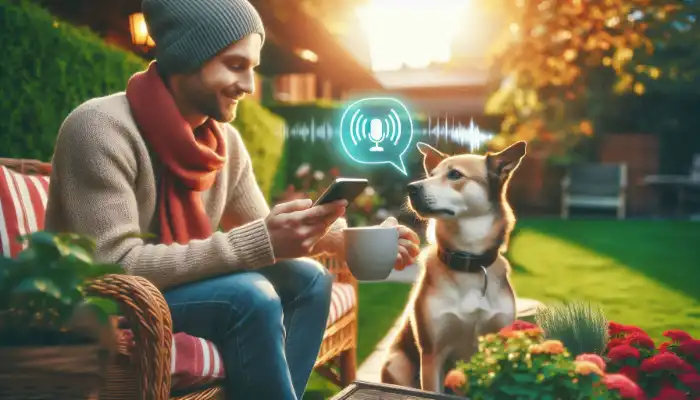
The Science Behind How Dogs Talk
Dog bark translator can understand dogs’ language, interpreting dog sounds is much more than simply sound production.
- Nonverbal Communication: Dogs possess varying barks that emanate in various frequency ranges and rhythms which portray emotion.
- Body Movement: A dog’s tail, ears, and even their eyes provide a great deal of information during communication.
- Communication via Scent: Dogs can mark territory through scent in addition to vocals, which is another dimension that vocal translators miss.
There is a steep technological barrier to embedding such features into a dog translator app, but it is still a focus for development.
Role of AI in Translation for Dogs
Artificial Intelligence enables the operation of dog translator online applications. These apps work by recognizing pet sound patterns, from barks and growls to barks and whines.
- Emotional Bark Analysis: Certain barking sounds are associated with certain feelings or needs. AI can be programmed to detect these emotions.
- AI Model Improvements: Utilizing smart technology, dog owners who use the app continuously add to the available data, resulting in better machine learning algorithms.
Understanding dog communication through science helps us connect better with our furry friends. So if you want to learn the meaning of different dog sounds, keep exploring the fascinating world of canine language!

Common Myths About Dog Behavior
Dogs don’t always do what we expect, and sometimes people misunderstand them. Let’s clear up some common myths about dog behavior so you can understand your furry friend better!
- The Myth of “Barking Means One Thing”: Dogs have different pitches of barking that can translate to many meanings. For example, a high-pitched bark may also signal that the dog is distressed.
- Importance of Context: Despite the insights derived from dog language translator applications, there is still a need to properly assess the actual context and the dog’s body language.
Now that you know the truth, you can treat your dog the right way. Remember, dogs have their way of thinking—so always be patient and kind!

Dog Translator App Problems: Should You Be Worried?
As fun and exciting as human to dog translator apps might be, their usage is surrounded by morality issues.
- Technology Misuse: Excessive use of these applications may result in clients misunderstanding the requirements and feelings of a particular dog, especially in cases of anxiety and/or pain.
- Overreliance on Applications: These applications are most useful if used as adjuncts to proper dog training and behavioral modification, but not as standalone solutions.
Evaluation of Dog Translator Applications
It is high time to evaluate existing human to dog translator applications.
| App Name | Features | Rating | Price |
|---|---|---|---|
| Bark Talk AI | Provides analyses of barks and feedback | ⭐⭐⭐⭐⭐ | Free/Paid |
| Doggie Decoder | Translation differs by breed | ⭐⭐⭐⭐ | Paid |
| Pawspeak | Recognition of emotions | ⭐⭐⭐ | Free |
Remember that every application has its caveats, and it is best to choose one that fulfills the client’s specific requirements.
Ways to Use Dog Translator Apps
Dog translator apps are gaining popularity, helping owners understand their pets better. Here are common everyday scenarios where these apps can be useful.
- Dog Training: A common application of human to dog translator apps is to assist pet owners in issuing commands and get them to observe their dog’s responses to certain words.
- Self-Teaching Aid: Such tools can assist pet owners to better understand their dogs and help them detect signs of anxiety, fear, or happiness in dogs.
The efficiency of a human to dog translator app relies on several aspects:
| Aspect | Efficiency |
|---|---|
| AI Training Data | Low accuracy because there is no proof of dog phonology. |
| Breed Differences | Alter phonations and vocalization of some breeds are more frequent than others. |
| Emotional Context | Barking is so multi-layered that showing the whole meaning is virtually impossible. |
While these devices are entertaining and useful, pet owners should exercise them together with fundamental dog training and behavioral modification techniques such as trying to understand different dog sound and behaviors.

The Best Dog Talk Apps in 2025
Due to the surge of AI-driven pet technology, there are quite a few English to dog translator that purport to allow pet parents to understand their pets better. Here is a review of the highest acclaim in 2025.
Ranking Of Best Talking Dog Apps From 2025
Here is a ranking of the best dog-talking apps in 2025 according to features offered, user reviews, and pricing options.
| App Name | Key Features | User Rating | Price |
|---|---|---|---|
| DogTalk AI | Real-time bark analysis, voice commands | ⭐⭐⭐⭐ (4.5/5) | Free & Paid Plans |
| BowWow Translate | AI-powered speech-to-bark conversion | ⭐⭐⭐⭐ (4.3/5) | Free |
| Dog Speak Pro | Custom commands, training assistant | ⭐⭐⭐ (4.0/5) | Paid Only |
| Pet Chat Bot | Emotion recognition, community sharing | ⭐⭐⭐⭐ (4.2/5) | Free |
Smart Dog Devices: What’s Next?
The field of dog communication is estimated to see promising developments in the future. These developments include:
- Voice Recognition: Dogs will be able to use devices that translate their vocal sounds into meaningful responses. For example, a barking device could be harnessed to interact with the app, ultimately relaying the owner’s commands.
- Integration with Wearables: Imagine a smart necklace that syncs with a dog speech translator app, allowing for the immediate assessment of the dog’s emotions and medical condition.
- Multisensory Features: AI could one day add images and motion to audio for better comprehension.
Discover the top-rated dog talk apps of 2025 and enhance your understanding of your furry friend’s needs and the meaning of different dog sounds. Embrace the future of pet communication with these AI-driven solutions.
New Tech Helps You Understand Your Dog
As time progresses, dog owners are slowly gaining access to new technologies and features through their phones. These new technologies include dog translator apps, which grant even more interactivity between owners and their pets.
- Bark to Text Mode: Certain dog owners are being offered apps that translate barks into writing, this allows them to gain insight into what the dog is trying to express in real-time.
- Command Training: Several dog-training apps have advanced interactivity features that teach and reinforce fundamental commands like sit, stay, and come.
Innovations and Their Impact on Dog Training Using Translator Apps
While reliant solely does not replace a trainer, dog translator apps can be a great asset for beginner dog owners who are just getting into the world of training their pets and want to understand different dog sounds.
- Real-time Feedback: The applications can help motivate favorable conduct and pinpoint possible training deficiencies through feedback provided immediately.
- Enhanced Understanding: Now with dog translator online tools, one can further personalize training sessions based on the dog’s emotional status.
New technologies are enhancing the way dog owners connect with their pets. Dog translator apps are just the beginning of a more interactive future for pet care.
Pros and Cons of Dog Translator Apps
Human to dog translator apps are gaining popularity, offering exciting possibilities for understanding our pets better. But, like any technology, they come with their own set of pros and cons.
Each app has its pros and cons.
Although many dog lovers appreciate the novelty introduced by dog translator apps, most also feel that it should never serve as a replacement for proper training and supervision. These apps should only be viewed as aids rather than the primary means of communicating with a dog. Experts suggest as much.
Pros:
- Other than to aid in training a dog, there is a good amount of entertainment value.
- Aiding the owner in interpreting a dog’s basic feelings.
- Additional tools for training are provided by some apps.
Cons:
- Some of the available features require payment.
- There is no guarantee of accuracy.
- It is untested, whether or not it is effective for all breeds.
While dog translator apps can bridge the communication gap, it’s important to weigh their benefits against potential limitations. Use them wisely to enhance your bond with your furry friend.
How to Use a Dog Translator App?
Using a human to dog translator app to learn different dog sounds can be easy, but without proper background knowledge of how the app operates, getting the most accurate bark-to-speech translation can be hard. Fret not, as here are some steps for you to make the most out of your barking buddy.
Step-by-Step Guide to Using a Human to Dog Translator
- Download the App – Head on to the App Store or Google Play and pick Bark Buddy. Make sure the app has great reviews before downloading.
- Enable Microphone Access – The application is permitted to capture audio of your dog’s barks for examination.
- Select Translation Mode – Some applications provide more than one mode, such as:
- Bark Translation – Figure out what your dog’s barks signify.
- Command Translation – Transform human sentences into barks.
- Voice Recording – Record different dog sounds for later comparison.
- Test with Simple Commands – Use basic commands such as “Sit” and “Let’s go outside” and observe your dog’s response.
- Adjust Settings for Better Accuracy – Some apps use machine learning to make estimations based on the dog’s species.
Understanding Different Modes
- Bark to Text Mode – Takes the barking sound and transcribes it into understandable words.
- Speech To Bark Mode – Enables people to “talk” in a way that dogs can understand.
- Custom Commands – Pet owners can create specific phrases and attach them to actions.
Tips For Improving Translation Accuracy
- To boost precision, test the app in a less noisy setting.
- While translation is being done, consider additional signs, such as the body movements of the pet.
- Try different pitches and vocabulary to get the best results.
While they may not provide a perfect solution to understanding dogs, a dog translator makes for a great way to interact and engage with your pet by understanding the meaning of different dog sounds and movements.
Apps and AI offer information, but true interaction with dogs occurs through watching, training, and cultivating an emotional connection. Both a dog translator online and a mobile app can be very helpful, but they should always be combined with more conventional approaches to achieve the best results with your pet.
Features of Dog Translator Apps.
Dog translator apps come with features that have been designed to assist owners in understanding their pets better. The accuracy of these apps, as discussed further below, is still questionable.
However, they provide some useful features that improve interaction between humans and dogs. As such, below are some of the most prominent features that a dog translator app has.
Simulated Barking Speech Output
- Converts human speech to simulated dog barks
- Allows pet owners to “speak” to their dogs in different barking tones.
- Helps in training sessions by strengthening voice commands with additive bark command sounds.
Text-to-Bark Interpretation
- Captures and interprets a dog’s bark.
- AI is used to analyze potential meanings e.g. happy, sad, hungry, and others.
- Delivers text-based output to assist dog owners with understanding their pet’s feelings.
Behavior Recognition & Training
- Different dog behavioral patterns are identified and classified.
- Keeps record of progress made in obedience training sessions.
- Tracks change in mood based on barking patterns.
Some Other Relevant Features
| Feature | Description |
|---|---|
| Custom Commands | Allows users to create personalized voice commands for their dogs |
| Soundboard Options | Offers pre-recorded dog sounds to grab a pet’s attention |
| Interactive Training Modes | Provides guidance on training based on bark responses |
Contemporary dog translator online applications combine these functions to enhance the accessibility of a pet owner’s experience. However, the efficiency of every detail differs from one application to another, as well as the responsiveness of the dog.
The Best Dog Translator Mobile App Vs Online Tool
One should understand the difference between mobile dog translator apps and online tools for dog translations to decide on using one or the other. Each alternative has its benefits and drawbacks.
The Difference Between Mobile Apps and Online Tools: Pros and Cons
| Feature | Mobile Dog Translator App | Dog Translator Online |
|---|---|---|
| Accessibility | Requires installation | Available instantly via web browser |
| Offline Functionality | Works without an internet connection (some features) | Requires internet access |
| Real-Time Communication | Faster processing and instant results | May have slight delays |
| Device Compatibility | Works on smartphones and tablets | Works on desktops and mobile browsers |
| Updates & Maintenance | Requires regular app updates | Automatically updated by developers |
Which Is More Efficient for Real-Time Communication?
With a dog translator mobile app, you do not need a connection; it works offline, which makes it more reliable for instant translations.
- Online tools do not require any downloading of software, which is convenient for quick use, however, they can be slower to respond.
- A dog translator depends on the user’s preference and how often they plan to use it.
A dedicated dog sounds translator is the most reliable solution for regular users, whereas occasional users may find a dog translator online easier.
Comparison Between Mobile Apps and Dog Translator Online
When using a dog sound translator app, as with any mobile application, it is important to note certain limitations that are different from using a dog translator online.
Each of them carries a set of advantages and disadvantages, and the optimal selection is contingent on your circumstances and liked features.
Advantages and Disadvantages of Mobile Apps and the Dog Translator Online Service
| Features | Dog Translator Online | Dog Translator Application |
|---|---|---|
| Portability | At all times on mobile phone or tablet | Internet-connected devices get access |
| Ease of Use | Cross-platform web application | Touchscreen supported |
| Offline Capability | No offline compatibility | Some apps can no longer work with the internet, just offline |
| Real-Time Communication | Most advanced, set custom voice commands | Wireless lag may cause delays |
| Customization | Custom commands are usually provided | Customization is restricted |
| Device Compatibility | Apple or Android phones and tablets | Internet-connected devices get access |
Who Does It Better When It Comes to Real-Time Communication?
If speed and efficiency are what you are looking for with a human to dog translator app, then the mobile version is almost always the best option. For instance, the dog app can translate barks or commands without missing a beat.
This app is great for speaking to your dog on the go. If you are thinking about a more relaxed setting, then an online dog language translator might be enough, especially after some tea and with the router next to me.
Dog Translator Apps: FAQs
How to speak dog language translator apps are gaining popularity, but how effective are they? Here are some answers to common questions about these apps and their role in understanding and training dogs.
1. Which Dog Translator App Is the Best?
An app can be developed to convert dog sounds to human speech. No application is perfect, but Barkly and Woof-Translator achieve a good measure of accuracy and customer satisfaction. Those applications provide general understanding but do not replace professional training for dog handlers.
2. Are Dogs Able to Understand Human Commands?
Through consistent repetition, dogs learn how to respond to certain commands. While they do not understand human language as a whole, they acknowledge specific orders and emotional expressions and may use body language and vocalization as a form of communication.
3. Is it Possible to Train Using a Dog Translator App?
Dog language translator applications will neither help nor substitute professional training; however, they can facilitate signifying commands and understanding a dog’s response better. Use them in conjunction with other training methods for the best results.
4. Are Dog Translator Mobile Applications Paid or Free?
There are some human to dog translator applications that are free while others require a subscription or one-time payment to get additional features. Free versions often have limited functionality, such as basic bark translations, while paid versions provide more in-depth features like command translations or breed-specific data.
5. How Bark Translation to Text is Done with Accuracy?
Most applications that provide dog language translation services do not translate barks to text inaccurately. At best, the apps can provide an interpretation as the technology interprets sounds based on algorithms and patterns, which makes the understanding general but never precise translations of every individual bark.
6. Are Dog Sounds Fully Captured by Dog Translator Applications?
Although dog language translator applications are built to capture wide-ranging dog sounds, such sophistication may not be achieved with utmost precision; the applications focus mostly on barks, growls, and whines, but like humans, dogs also rely on non-vocal cues such as body language as well as facial expressions.
7. Are Dog Translator Apps Safe for My Dog?
Most dog language translator apps are usually safe. The kinds of sounds emitted are not harmful to dogs. Just be sure to always analyze your dog’s reaction to the app’s sounds and ensure that it does not induce any stress or anxiety.
While dog translator apps offer fun insights into dog communication, they are not a substitute for professional training. Use them alongside other methods for the best results in understanding your pet.
Conclusion
Dog translator apps are a fun and innovative way to engage with your pet, offering a deeper understanding of different dog sounds and what they mean. While these apps are not a replacement for professional training, they can enhance communication and help identify your dog’s feelings.
With the continuous improvement of AI and machine learning, dog translators are becoming more accurate, allowing pet owners to better interpret their dog’s companion’s barks, whines, and growls. However, it’s important to remember that context and body language still play a key role in understanding your dog.